
China Unfiltered: A Firsthand China Travel Itinerary from Beijing to Shanghai

Updated: Aug 13
Beijing • Xi’an • Suzhou • Shanghai, April 16 - 27, 2026
Introduction: An Invitation I Couldn’t Refuse
When I was invited to experience an Air Canada Vacations curated China itinerary firsthand, I didn’t hesitate. This China travel itinerary would take me from Beijing to Xi'an, Suzhou and Shanghai, offering a firsthand look at a country of extraordinary contrasts. China had always been one of those destinations that felt distant, almost mythical—rich in history, complex in culture, and constantly in the headlines. I was curious, excited… and, if I’m honest, not entirely sure what to expect.
What I didn’t expect was just how much it would challenge my assumptions.
From the moment I landed in Beijing to my final night overlooking the skyline of Shanghai, this journey was a constant contrast of old and new, tradition and innovation, familiarity and surprise. China didn’t just meet expectations—it quietly, confidently exceeded them. And along the way, I realized something important: what we think we know about a place—and what it actually feels like to be there—can be two very different things. This itinerary took me through imperial palaces, ancient wonders, tranquil gardens, and some of the most futuristic cityscapes on the planet. But more than that, it offered a glimpse into a country that is evolving at a pace that’s hard to fully grasp until you see it for yourself.
So here’s what it’s really like to experience China in 2026—and a few things you’ll want to know before you go.
The Day Before I Leave
Before we begin, I want to share a quick personal note—because even as a travel advisor, I’m not immune to the stress that comes with flight disruptions. I often hear the frustration on the other end of the line, and while I’m there to help navigate it, I also understand it on a personal level—because I experience those same moments of uncertainty myself.
This particular trip to China was arranged through a groups department, which meant I didn’t have the usual level of access or control I’m accustomed to. I couldn’t view my flight details online until check-in—and even then, only from a desktop. It’s a small detail, but one that left me feeling slightly disconnected from my own itinerary.
About 36 hours before departure, around 10:00 PM, I decided to take a quick look at my flight status on a flight tracker site online—just for peace of mind.
That’s when I saw it.
My domestic connecting flight—the one that would get me to my international departure—had been cancelled. No notification. No update. Just… gone.
Understandably, I was now wide awake! A few emails, a couple calls and with only 10 hours before my new flight, I finally had a solution. But it wasn’t the smooth, seamless start I had envisioned. For a moment, I felt exactly how many travelers do in these situations: uncertain, out of control, and a little overwhelmed.
And that’s exactly why this story matters.
Because travel isn’t just about the destinations—it’s about navigating (and accepting!) the unexpected along the way. And as this journey to China unfolded, it became so much more than an itinerary. It became a reminder of resilience, perspective, and the beauty that can still emerge, even when things don’t begin as planned.
So, let me take you to China… ✈️
Day 1–2: Leaving Canada Behind, Landing in the Future
April 17/18: The journey begins with a treacherous drive in some brutal and sudden winter conditions. It was some difficult driving that's for sure! I slid into Calgary, completely iced inside my car, and hoped this would be the worst thing I had to deal with for the next two weeks! I had finished dealing with the flight arrangements (above) as I spent the night. I now had an early morning flight from Calgary to Vancouver. It was delayed 2 more hours, and that uneasy feeling came back. But finally - lift off to Vancouver! The Vancouver airport is so lovely, one of my favorites, especially their indoor/outdoor atrium.
After a 6 hour layover in Vancouver - and getting 13,000 steps in at the airport before my 10.5 hour flight - I was off to Beijing! Arrival in Beijing is seamless when arriving with a group; I can understand how it would be difficult for anyone not speaking Mandarin. We were greeted, transferred, and within hours sitting down to a welcome dinner that signals what’s ahead: bold flavors, precision, and a sense that everything runs just a little more… efficiently.
💡 Insider Secret #1: Airport arrivals here are far smoother than most Canadians expect—but there are still a few common tourist missteps that can cost you time. Ask me before you go.
Day 3: My China Travel Itinerary: Beijing, Xi'an, Suzhou & Shanghai
April 19: The day starts at the Temple of Heaven, where ancient spirituality meets quiet symmetry. The Temple of Heaven in Beijing dates back to the early 15th century, during the reign of the Yongle Emperor of the Ming Dynasty (the same emperor who built the Forbidden City). Constructed in 1420, it wasn’t a temple in the traditional sense, but a sacred ceremonial site where emperors—considered the “Sons of Heaven”—would perform elaborate rituals to pray for good harvests and harmony between heaven and earth. These ceremonies were incredibly important, because the emperor’s legitimacy was believed to depend on maintaining this cosmic balance.
The most iconic structure, the Hall of Prayer for Good Harvests, is a stunning circular wooden building built entirely without nails, symbolizing heaven, while the surrounding layout reflects ancient Chinese beliefs about the universe—round heaven and square earth. I couldn't get over the vibrant colors and detail!
For centuries, ordinary citizens were not allowed inside. Today, it’s a UNESCO World Heritage Site and a peaceful public park, where locals gather for tai chi, music, and dance—transforming what was once an exclusive imperial altar into a shared cultural space.
Walking into Tiananmen Square is humbling—its sheer scale dwarfs anything in Canada. The square has evolved dramatically over the centuries, reflecting China’s shifting political and cultural identity.
Originally created in the 15th century during the Ming Dynasty, it began as a ceremonial forecourt outside the Imperial City, used for imperial announcements and gatherings. Its name comes from the nearby Tiananmen Gate (“Gate of Heavenly Peace”), the grand entrance to the Forbidden City.
The square we see today took shape in the 20th century, especially after 1949 with the founding of modern China. It was expanded into one of the largest public squares in the world, designed for national events and public gatherings, and surrounded by landmarks like the Great Hall of the People and the Monument to the People’s Heroes. Today, Tiananmen Square stands as both a symbol of national pride and a space layered with history—some openly commemorated, and some more quietly understood.
It is also a place tied to more recent and complex history. In 1989, Tiananmen Square was the site of large-scale student-led protests that ended in a military crackdown and numerous brutal deaths—an event widely discussed internationally, but still considered a sensitive topic within China today. During our visit, we were advised we were not allowed to speak about these events while visiting, a reminder that history can be experienced very differently depending on where you are in the world.
From there, we stepped into the legendary Forbidden City, a UNESCO site that feels less like a museum and more like stepping into a living timeline of emperors and dynasties. It is one of the most extraordinary imperial complexes in the world, built between 1406 and 1420 during the Ming Dynasty. For nearly 500 years, it served as the political and ceremonial heart of China, home to 24 emperors from the Ming and Qing dynasties. Known as the “Forbidden City” because access was strictly limited—only the emperor, his family, and select officials were allowed inside—it was a world unto itself, complete with palaces, courtyards, and halls designed to reflect absolute power and cosmic order.
The layout follows traditional Chinese cosmology, with symmetry, hierarchy, and symbolism embedded in every detail—from the golden rooftops representing imperial authority to the north-south axis aligning with ancient beliefs about harmony between heaven and earth.
After the fall of the last emperor in 1912, the complex was eventually transformed into the Palace Museum. Today, it’s a UNESCO World Heritage Site and one of China’s most visited landmarks, offering a rare glimpse into the scale, ceremony, and control of imperial life.
The last site at this complex was the Imperial Garden of the Forbidden City, located inside the grounds of the Forbidden City in Beijing. It was built in 1416 during the Ming Dynasty as part of the original palace complex and was used as a private retreat for the emperor, empress, and imperial family. Unlike the grand ceremonial courtyards elsewhere in the Forbidden City, this space was designed for rest, reflection, and leisure.
The garden follows classic Chinese imperial design principles, combining natural elements with symbolic order. It features ancient cypress trees, rock formations, winding paths, pavilions, and carefully arranged plants—each element chosen to reflect harmony between nature and human design, a key idea in traditional Chinese philosophy.
Despite its beauty, it was also highly controlled and secluded—only members of the imperial household and select attendants could enter. It served as a quiet counterbalance to the formality and political intensity of court life just steps away. Today, it remains one of the most peaceful areas within the Forbidden City, offering visitors a glimpse into the private world of China’s emperors after centuries of public ceremony and state power.
It was lovely to see the Chinese people dress up in traditional dresses and have their photos taken. They are a proud nation steeped in tradition. It was incredible to see that kind of pride; and it made me realize I don't see that in Canada anymore.
Day 4: The Great Wall & Hidden Beijing
Beijing
April 20: Waking up this morning, I was like a little kid - SO excited to finally get to see the wall today!
Tourist Trap #1: Jade “Factory” Stop
Before heading to the Great Wall, we made our first stop at a jade “factory.” Rather than an insight into craftsmanship, it felt more like a heavily guided retail experience focused on showcasing products. We were there for nearly two hours, and it quickly became clear this was a scheduled filler rather than an optional cultural stop. While jade is undeniably significant in Chinese culture, this visit didn’t really reflect that in a meaningful or educational way. It also began to feel like valuable time was being taken away from what we had actually come to see—the Great Wall itself.
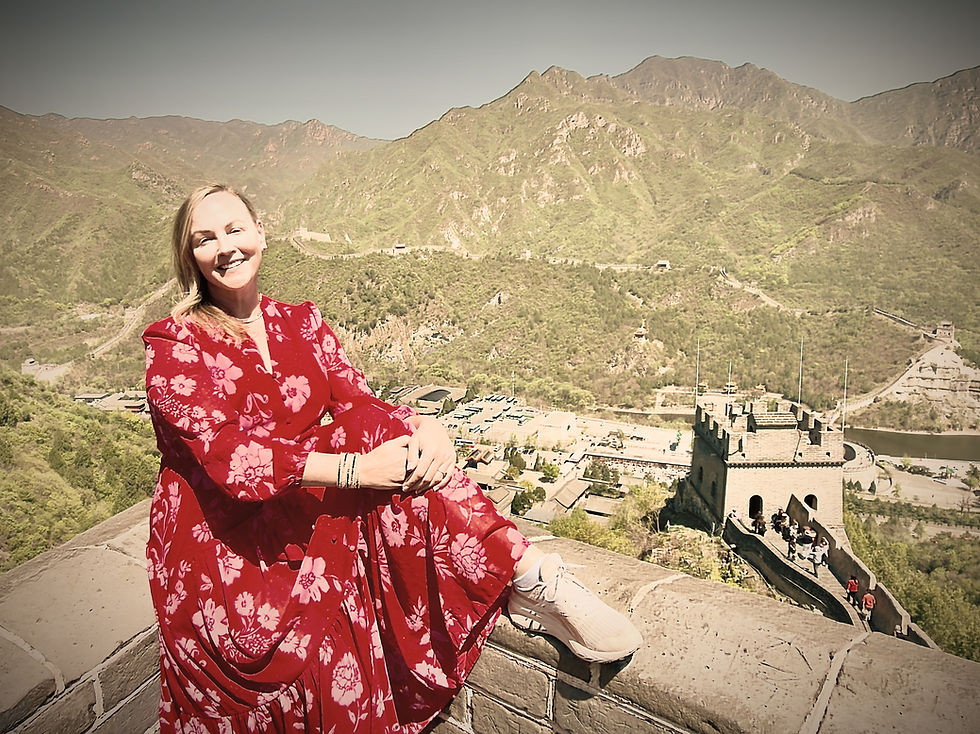
Finally, back on the bus and headed to The Great Wall of China! No photo prepares you for the Great Wall of China. Climbing even a small section gives you a real sense of its scale—and the ambition behind it. The wall stretches an astonishing 21,000+ kilometers across northern China, making it one of the longest man-made structures in the world. Rather than a single wall, it’s a vast network of fortifications—walls, watchtowers, and passes—built over many centuries. Construction began as early as the 7th century BC, when smaller states built defensive barriers. The first major unification came under Qin Shi Huang around 221 BC, who connected and expanded existing walls to defend against northern invasions. However, much of what travelers see today was constructed during the Ming Dynasty, between the 14th and 17th centuries, when the wall was rebuilt using brick and stone for greater strength and durability.
As for the human cost, it’s estimated that hundreds of thousands—possibly over a million—workers died during its construction. Laborers included soldiers, peasants, and prisoners, many working in harsh, remote conditions with limited resources. Because of this, the wall is sometimes referred to as the “longest cemetery on Earth,” though this is more symbolic than literal.
Today, the Great Wall stands not only as a defensive masterpiece, but as a powerful reminder of the scale, ambition, and human effort behind one of history’s most iconic achievements.
Then comes another memorable experience: drifting through the old Hutongs by rickshaw, stepping into a local family home. A hutong refers to the narrow alleyways and traditional courtyard neighborhoods found in older parts of Beijing. These lanes date back to as early as the Yuan Dynasty (13th century) and were designed as residential communities built around Siheyuan—courtyard homes where multiple generations of a family would live together. The layout wasn’t random; hutongs were often arranged in a grid pattern reflecting social hierarchy and traditional Chinese urban planning.
Walking through a hutong is like stepping into a quieter, more intimate version of Beijing. You’ll see locals playing cards, hanging laundry, cooking, and going about daily life—offering a stark contrast to the city’s modern high-rises and busy avenues. Today, many hutongs have been preserved as cultural heritage sites, while others have been renovated into trendy areas with cafés, boutiques, and guesthouses.
💡 Travel Insight: Some hutongs are beautifully authentic, while others have been heavily commercialized for tourism—so the experience can vary a lot depending on where you go.
💡 Insider Secret #2: Not all Hutong tours are equal—some are heavily commercialized. There are ways to experience the authentic side most tourists never see.
Day 5: Bullet Trains & Tang Dynasty Nights
Beijing • Xi-an
April 21:
Tourist Trap #2: Traditional Chinese Medicine Centre
We woke and had another leisurely breakfast (delicious!!) and set off to visit to a Traditional Chinese Medicine center. On the surface, it was interesting to be introduced to centuries-old healing practices that are still used today. However, the experience again leaned heavily toward a commercial presentation to which many in my group fell prey to $1000 'medicinal tea leaves' (where I quietly shook my head and wondered how they would get that back into Canada). At this point, I was starting to notice a pattern forming—these structured “learning” stops that felt more like sales opportunities than cultural immersion—and it left me wanting something more authentic and less staged.
Then, the real surprise: China’s high-speed rail. Smooth, fast, and shockingly efficient, it carries you to Xi'an—once the capital of 11 dynasties. I managed to get 2 hours of a time lapse on the train, condensed to 37 seconds! Our ride was 4 hours long so it was a great time to organize my photo collection and do a little work.
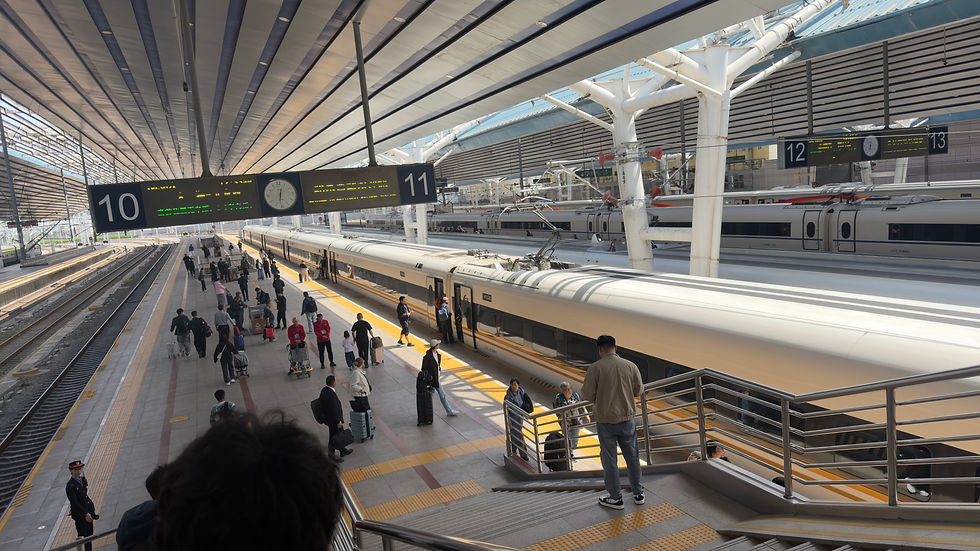
Arriving in Xi-an was cold: six degrees and rainy. I'm so glad I packed jeans and jackets! We settled into our hotel and got ready for supper and an evening walk.
That evening, Grand Tang Everbright City comes alive with lights, performances, and the chance to step into Tang Dynasty culture—literally. We had a night of dress up in traditional Chinese costume, and then walked through the streets as so many locals do. We were quite a spectacle and many asked to take photos of us. I had wanted to truly see Everbright, to wander around the high-energy area. We simply couldn't in our dress so that was a big disappointment for many of us for sure. As a group we were inundated with locals taking our pictures and the whole experience felt very awkward! Despite that - here is my photo and I am pretty sure were made it to TikTok somewhere, as many cameras were on us.
Day 6: The Eighth Wonder
Xi-an
April 22: I was excited as today I would see the Terra Cotta Warriors!! But first...
Tourist Trap #3: Terracotta “Factory” Visit
Our first stop of the day was a Terracotta “factory,” which continued the same trend. While it was interesting to briefly see some of the techniques and craftsmanship behind the famous figures, the overall visit felt more like an itinerary filler than a genuine cultural experience. The post-presentation sales focus was particularly noticeable here, and by this stage of the trip, it was starting to feel repetitive and somewhat predictable, which took away from what could have been a much more engaging stop.
Finally, we leave and head to the site. The Terracotta Army is one of those places that truly exceeds expectations. Thousands of life-sized warriors, each unique, standing guard for over 2,000 years.
Few sights in China leave quite the impression of the Terracotta Army. Discovered in 1974 by local farmers near Xi'an, this vast underground army was created over 2,000 years ago to guard the tomb of Qin Shi Huang in the afterlife.
What makes the site so extraordinary isn’t just its scale—thousands of life-sized soldiers, horses, and chariots—but the detail. Each figure has distinct facial features, expressions, and positioning, no two exactly alike. It’s a powerful reflection of the ambition and resources of China’s first emperor, as well as the incredible craftsmanship of the artisans who built it.
Walking through the excavation pits today, you can’t help but feel a sense of awe. It’s one of those places where history doesn’t just feel distant—it feels almost alive, standing silently in formation for more than two millennia. I was in awe... it was incredible to see firsthand what laid sleeping in the earth for centuries.
Later, walking along the Xi'an City Wall gives you a panoramic view of old meeting new.
Dinner introduces Shaanxi cuisine—rich, hearty, and completely different from what most Canadians think of as “Chinese food.”
Day 7: Suzhou – China’s Elegant Escape
Xia-an • Suzhou
April 23: After a flight from Xi-an to Shanghai, we continue to Suzhou, often called the “Venice of the East.” With such a short stay in a lovely city, the next stop annoyed me....
Tourist Trap #4: Silk Factory Tour
The final stop in this series was a silk factory tour, and by now the pattern was unmistakable. While there were still interesting elements in learning about the silk-making process, the experience itself felt primarily geared toward shopping rather than cultural understanding. After several similar stops throughout the itinerary, it had become increasingly difficult to stay engaged, and it felt like these visits were more about filling time than enriching the journey.
To hear more about what I experienced at these kinds of stops—and how you can better navigate or even avoid them when planning your own trip—feel free to reach out when booking China and I can help out!
💡 Insider Secret #3: Silk factories are fascinating—but not all offer genuine quality. There are ways to tell what’s real vs. tourist-grade.
An evening cruise along the Grand Canal reveals a slower, more poetic side of Suzhou. As the sun sets and the lights begin to reflect off the water, the city takes on a completely different rhythm—quieter, softer, and almost dreamlike.
I really loved this part of the day. After the pace and intensity of exploring larger cities, this felt like a chance to slow down and simply take it all in. The reflections of traditional buildings along the canal, the gentle movement of the boat, and the calm atmosphere created a moment of real stillness in the middle of a busy itinerary.
It was less about “seeing” and more about feeling present—one of those simple, scenic moments that stays with you long after the trip is over.
Day 8: Quiet Gardens to Night Life
Suzhou • Shanghai
April 24: In the morning we visited The Lingering Garden (below) in Suzhou, which is a masterpiece of design—every corner intentional, every view curated. It was first created in 1593 during the Ming Dynasty by Xu Taishi, a government official, and was originally called the “East Garden.” Like many elite private gardens of the time, it was designed as a place of retreat—an escape from political life into a carefully constructed natural world.
During the Qing Dynasty, the garden changed ownership and was significantly expanded and redesigned. It gained the name “Lingering Garden,” reflecting the feeling it was meant to evoke: a place so beautiful that visitors would want to linger and never leave.
The garden is famous for its masterful use of space and symbolism. Instead of large open landscapes, it uses winding paths, framed views, rock formations, ponds, and covered walkways to create the illusion of a much larger world. Every turn is intentionally designed to reveal a new perspective—like a living painting.
Like many historic sites in China, it suffered damage over time, especially during periods of political upheaval, but it was carefully restored and later recognized as a UNESCO World Heritage Site as part of the Classical Gardens of Suzhou.
Today, it remains a quiet masterpiece of balance, philosophy, and design—where architecture and nature are meant to feel completely inseparable.
The Huangpu River night cruise? Pure magic. Neon reflections, silent electric boats, and a skyline that feels like 2050. The tallest building in Shanghai is the Shanghai Tower which stands at 632 metres (2,073 feet) and is currently the tallest building in China and the second-tallest in the world.
Located in the Pudong financial district, it has a distinctive twisting design that reduces wind load and improves energy efficiency. The tower contains offices, hotels, observation decks, and retail space, and its glass façade spirals upward in a way that symbolizes modern Shanghai’s rapid development.
At night, it becomes part of the iconic skyline you see from the Bund—alongside the Oriental Pearl Tower and the Shanghai World Financial Center—creating one of the most recognizable cityscapes in the world.
Day 9: Shanghai – Where the Future Lives
Shanghai
April 25: We wake up for a walk along The Bund, colonial architecture stands across from the futuristic skyline of Pudong—a visual metaphor for China itself. The The Bund is one of the most historically and culturally significant areas in Shanghai, and it essentially tells the story of the city’s transformation.
Historically, the Bund was the center of Shanghai’s international trade and foreign influence in the 19th and early 20th centuries. Along this stretch of riverfront, European banks, trading houses, and consulates were built, creating a striking line of colonial-era architecture that still stands today. Because of this, the area became known as the financial heart of “old Shanghai.”
Its importance isn’t just historical—it’s also symbolic. The Bund sits directly across the river from Pudong, where Shanghai’s futuristic skyline has risen in recent decades. This contrast is intentional in how people experience the city: on one side, the preserved past; on the other, the rapid, modern growth of China’s economic rise.
Today, it’s one of the most iconic viewpoints in Shanghai, offering a powerful visual of how the city bridges its colonial history with its role as a global financial hub.
From there, I made my way to the Shanghai History Museum, which ended up being a highlight of the day. Beyond its beautifully curated collections of ancient ceramics, bronzes, and calligraphy, what really resonated with me was learning about the Jewish history connected to Shanghai. During World War II, the city became a place of refuge for thousands of Jewish families fleeing Europe—one of the few places in the world that did not require a visa at the time. That piece of history added such a meaningful, human layer to the experience, and made the visit feel far more personal than I had expected.
Later in the day, I explored the lively markets around the City God Temple of Shanghai. The whole area is full of energy—narrow walkways packed with vendors, the smell of street food in the air, and little corners where you can easily stumble across something unexpected. It’s the kind of place where wandering without a plan is part of the fun.
Afterwards, I spent the afternoon in the Former French Concession, one of Shanghai’s most charming and character-filled districts. Once a foreign settlement established in 1849, it still carries traces of its European past, with tree-lined streets, older colonial-style buildings, cafés, and boutique shops.
Today, it’s loved for its relaxed, walkable atmosphere and creative feel. It offers a quieter contrast to the city’s modern skyline—an easy place to slow down, wander, and appreciate a different layer of Shanghai’s history and personality.
Dinner, however… was a bit of an experience. I tried traditional Chinese hot pot—and let’s just say, it wasn’t for me. The concept of cooking your own meat in boiling broth at the table is something many people love, but I struggled with it. It’s one of those “guess I tried it” moments… but not one I’d rush back to. And honestly, that’s part of travel too.
Not every experience is going to be your favorite, but each one adds to the story. And in a city like Shanghai—where the future meets tradition at every turn—that contrast somehow feels perfectly fitting.
💡 Insider Secret #4: Shanghai has incredible shopping—but also some of the most convincing tourist traps in the world. Knowing where not to buy is just as important.
Day 10: Heading Home… With a New Perspective
Shanghai • Vancouver • Calgary
The return flight to Vancouver feels different. It’s not just a journey home—it’s a quiet pause to take everything in. You’re not simply carrying photos and souvenirs, but a collection of moments, contrasts, and experiences that shift how you see a place… and how you see travel itself.
This journey with Air Canada Vacations, like many group-style itineraries, came with both clear advantages and a few drawbacks.
On the positive side, the trip offered excellent value for money. The accommodations throughout were consistently impressive, and having all logistics—intercity transfers, transportation, and coordination—taken care of made travel through such a large and complex country far more seamless. Travelling in a small group with an English-speaking driver also added a layer of ease and reassurance, especially when navigating multiple cities. Flights from Calgary to Vancouver and Beijing, then Shanghai to Vancouver and back to Calgary, all bags, transfers, bullet train and domestic China flight, private guide and driver, plus several lunches and dinners, entry fees to exhibits - all included. It was great value for money.
That said, the structure did come with limitations. The schedule was quite rigid, leaving little room for flexibility or personal exploration. An early flight disruption added unnecessary stress, and numerous scheduled stops that felt more like commercial or tourist-focused visits than meaningful cultural experiences, which at times took away from the overall flow of the journey.
Despite these considerations, the overall experience was still highly impactful and memorable.
It also reinforced a principle that often holds true in travel: value and experience tend to align with investment. There is absolutely a place—and a traveler—for this type of tour, and part of my role is ensuring each client is matched with the experience that best suits their expectations and travel style.
At a lower price point, itineraries are often more structured and may include commercially driven stops that don’t always align with every traveler’s preferences. With a higher investment, there is typically greater flexibility, fewer of these inclusions, and a more curated, personalized experience.
From my perspective, as someone who travels frequently, I can accept a few trade-offs if it allows me to take multiple trips in a year - we all have a budget! However, for those travelling less often and looking for a more refined, seamless experience, it’s absolutely possible to design an itinerary that prioritizes authenticity and minimizes those types of stops.
Either way, the goal is the same—finding the right fit for the right client- so your time in destination feels meaningful, enjoyable, and truly your own.
And this is where this part of my story ends. In Part Two (which will come when I finish unpacking and organize my thoughts on the next blog!) I’ll explore a comparison between China and Canada—two very different worlds, and what stood out most when experiencing them side by side. It leaves me questioning again, as many of my trips do: "Why do I live in Canada?"
Ready to See China for Yourself?
China is one of those destinations where how you experience it makes all the difference. With the right planning, you can skip the unnecessary stops, avoid the tourist-heavy distractions, and focus on the moments that truly bring each destination to life.
If you’re thinking about travelling to China, I’d love to help you do it in a way that feels more intentional, seamless, and tailored to you. Reach out and we can make that happen!
And to finish it off—here are a few of my favorite memories and a collection of snapshots from the journey.


Comments